


“Neither the growers nor the authorities took it seriously enough. Everyone looked the other way a little, and that looking away is the reason we’ve ended up where we ended up,”
says Ákos Molnár, a board member of the Hungarian National Council of Wine Communities and president of the Sopron wine region, speaking to Qubit. Flavescence dorée, a grapevine disease caused by a phytoplasma infection, has been plaguing Hungary’s wine regions for close to fifteen years. In all that time, neither the government, nor the authorities, nor the growers took it seriously or reckoned with the far-reaching consequences its spread could bring – and a lack of state capacity made containing it harder still.
The infection is spread by the American grapevine leafhopper, and although the disease poses no danger to humans, in recent years it has reshaped the regional wine market. In Austria, the authorities acted quickly against the disease, yet the infection has kept spreading, while in Romania it took years for the authorities to respond seriously to the disease spreading from one vineyard to the next.


- Flavescence dorée is present in 18 of Hungary’s 19 counties, and according to the most pessimistic forecasts, 30–50 percent of the country’s vineyards could be lost. The disease is also spreading in Austria, and it threatens Romania’s largest wine-growing area too. In this article, together with journalists from Austria’s DOSSIER and Átlátszó Erdély, we trace how we got here.
- The phytoplasma that causes flavescence dorée was first detected in Hungary in 2013, but the invasive American grapevine leafhopper that spreads the bacterium had already appeared in 2006. It took the combination of the two for the disease to take hold.
- In Austria, flavescence dorée was first detected in vineyards in 2009, and in Romania in 2021. That year, Romania carried out four laboratory tests. Today the disease is present in several Austrian states and in several parts of Romania.
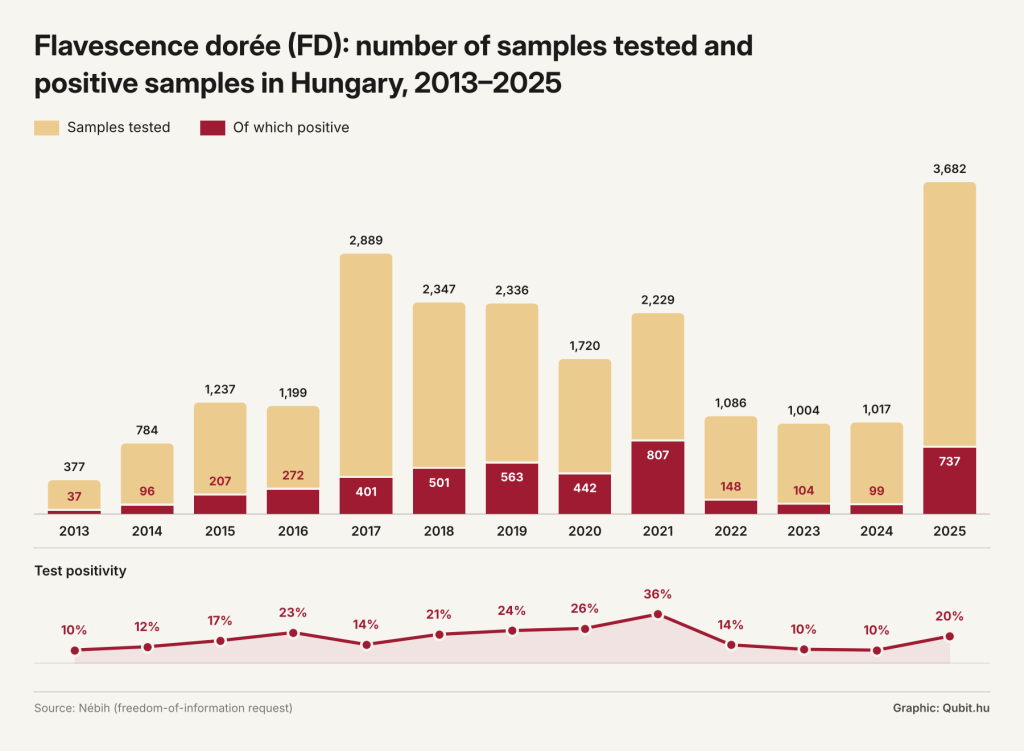
- Through a freedom-of-information request, we obtained the number of tests carried out by the Hungarian National Food Chain Safety Office (Nébih). The figures show that few tests were done in 2023–2024, the period that proved crucial to the outbreak’s escalation.
- Diseased plants must be removed as soon as possible, yet for years no one actively looked for them in Hungary. In some cases, infected vines stayed in vineyards for months while the process moved from sampling to the issuing of a removal order.
- The disease can also spread through infected propagation material. A heat treatment could make the material disease-free, but it is very expensive, and no one wants to pay for it.
- For years, growers had no incentive to report outbreaks of flavescence dorée. The fragmentation of Hungary’s public administration and the previous government’s late involvement also held back the response. The new Tisza government led by Péter Magyar and the new parliament have tightened and accelerated measures against flavescence dorée and broadened eligibility for compensation.
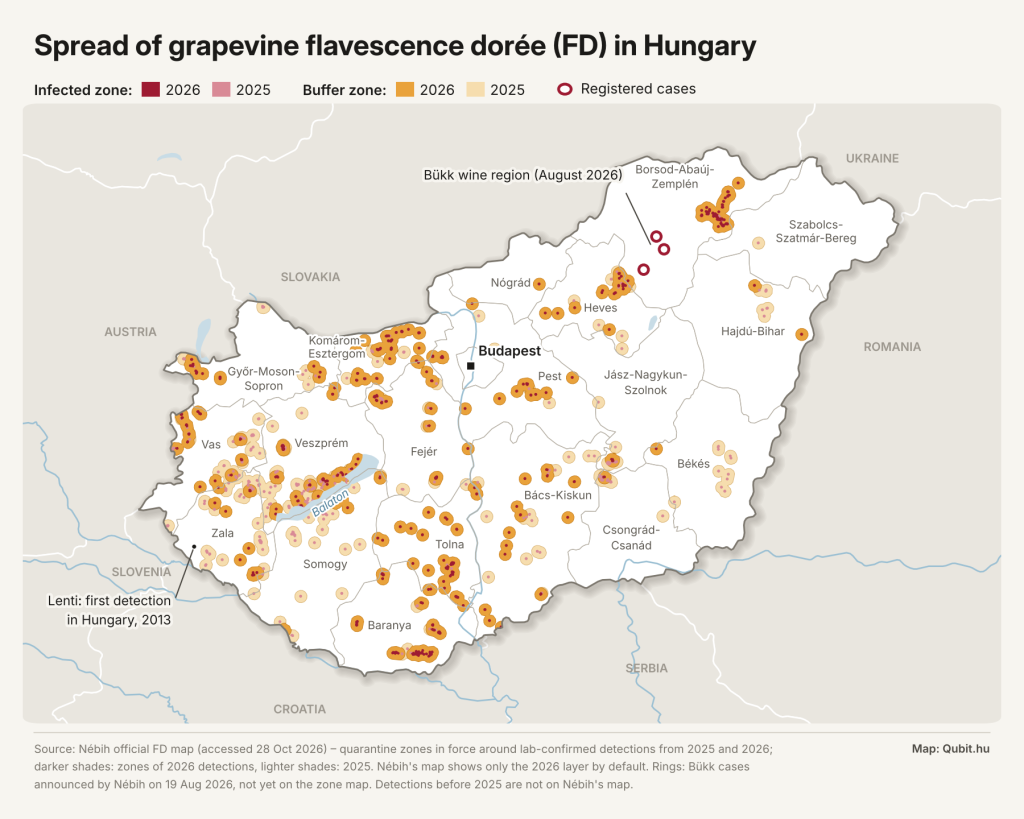
By August 2026, Nébih had confirmed the presence of flavescence dorée in 18 counties and 22 wine regions. Infection is severe in Zala County, on the northern and southern side of Lake Balaton – parts of Veszprém and Somogy counties – and, since this season, in the country’s northeast as well.
In response to Qubit’s freedom-of-information request, Nébih provided no information on either the size of the affected area or the number of vineyard holdings subject to officially ordered control measures, saying it did not have these data.
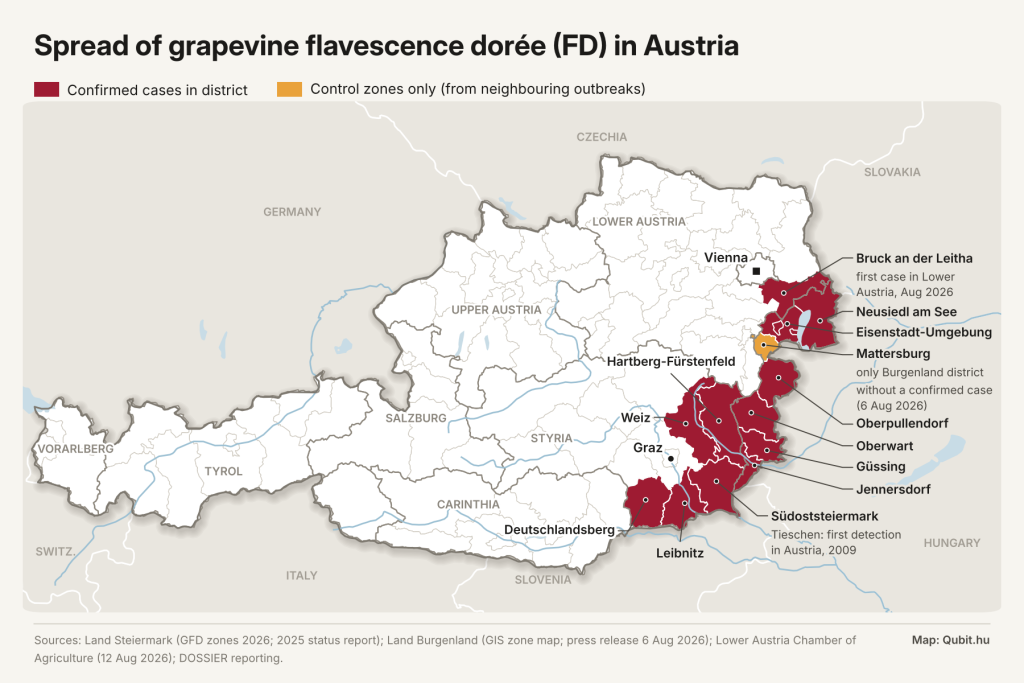
Like Hungary, Austria has no national tally either. Asked by DOSSIER, the Austrian agriculture ministry said it had no specific data on how many hectares of vineyards are affected, because keeping track of them is the responsibility of the states and the regional plant protection bodies. Such figures are badly needed, because the disease, which spread out of southern and southeastern Styria in the late 2000s, now affects all of Burgenland and has also been detected for the first time in Lower Austria.
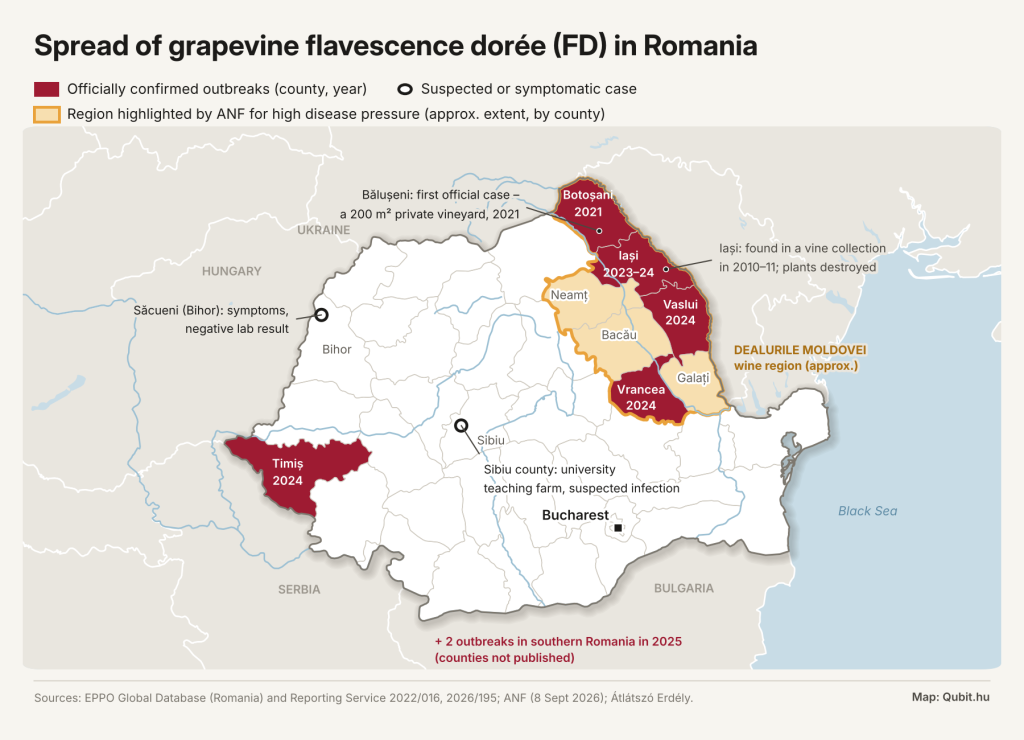
In Romania, according to the plant health authority, flavescence dorée has put pressure mainly on the Moldavian Hills, which produced more than half of the country’s grape harvest last year.
Péter Gál, head of the viticulture and oenology department at the Ministry of Agriculture and Food Economy, told Qubit that at the start of the year 17 percent of Hungary’s vineyard area lay within infected zones and 28 percent within buffer zones – the three-kilometre band surrounding infected areas. According to Gál, these zones may by now cover 50–60 percent of Hungary’s roughly 56,000 hectares of vineyards.
“What we’re seeing is the tip of the iceberg,”
said László Garamszegi, director general of the Centre for Ecological Research in Hungary, about the epidemic. Vines infected with the phytoplasma can go a long time without showing symptoms while the pathogen is still present, and PCR tests are not always sensitive enough to detect the infection.
Meanwhile, to support control efforts in Hungary and track where the infection is appearing, Nébih released a modern, interactive map on 2 June. In July, the Hungarian Ministry of Agriculture and Food Economy, led by Szabolcs Bóna, amended a decree so that compensation can be claimed more than once. And a legal amendment passed by parliament in October makes it easier to grub up neglected vineyards, which can act as sources of infection.
Everyone thought it wouldn’t happen to us
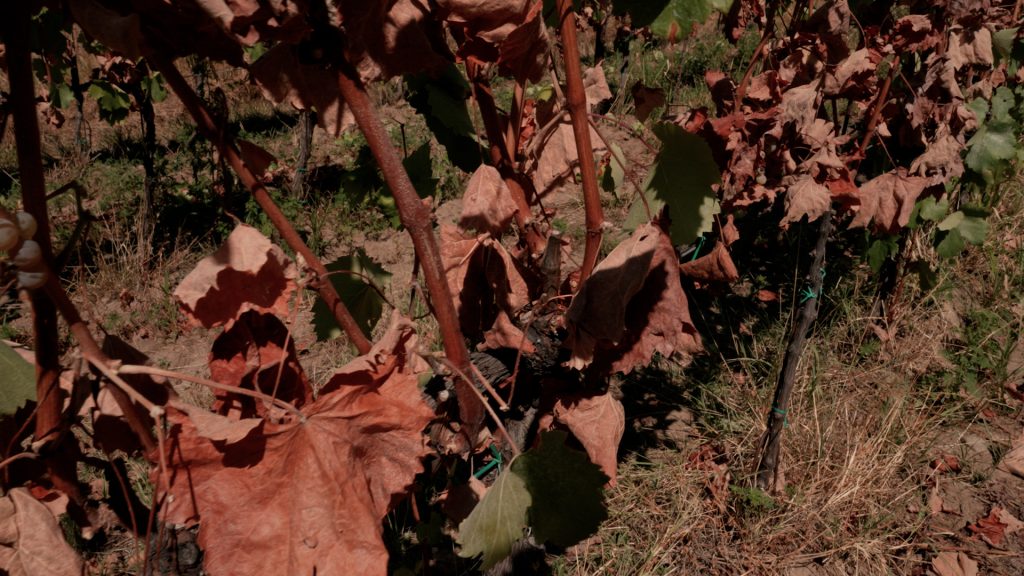
Flavescence dorée, which sharply reduces grape yields, is caused by phytoplasma – the bacterium Candidatus Phytoplasma vitis, a parasite of the plant’s phloem. In white-berried varieties the infection turns the leaves yellow; in red varieties it turns them red. It often comes with the leaves rolling downward into a roughly triangular shape, and with stunted fruit development.
- In Austria, the infection was first detected in 2009 in Tieschen, in southeastern Styria near the Slovenian border.
- Nébih’s predecessor began looking for symptoms of flavescence dorée in Hungarian vineyards as early as the 1990s, and the pathogen was first detected in 2013 in Lenti, in Zala County.
- Local quarantine measures were imposed because of the phytoplasma, which probably came over from Slovenia. In June 2014 Nébih drew up a plant health contingency plan to stop the disease from spreading.
- In Romania, flavescence dorée was officially detected in vineyards for the first time in 2021, in Botoșani County in the country’s far northeast.
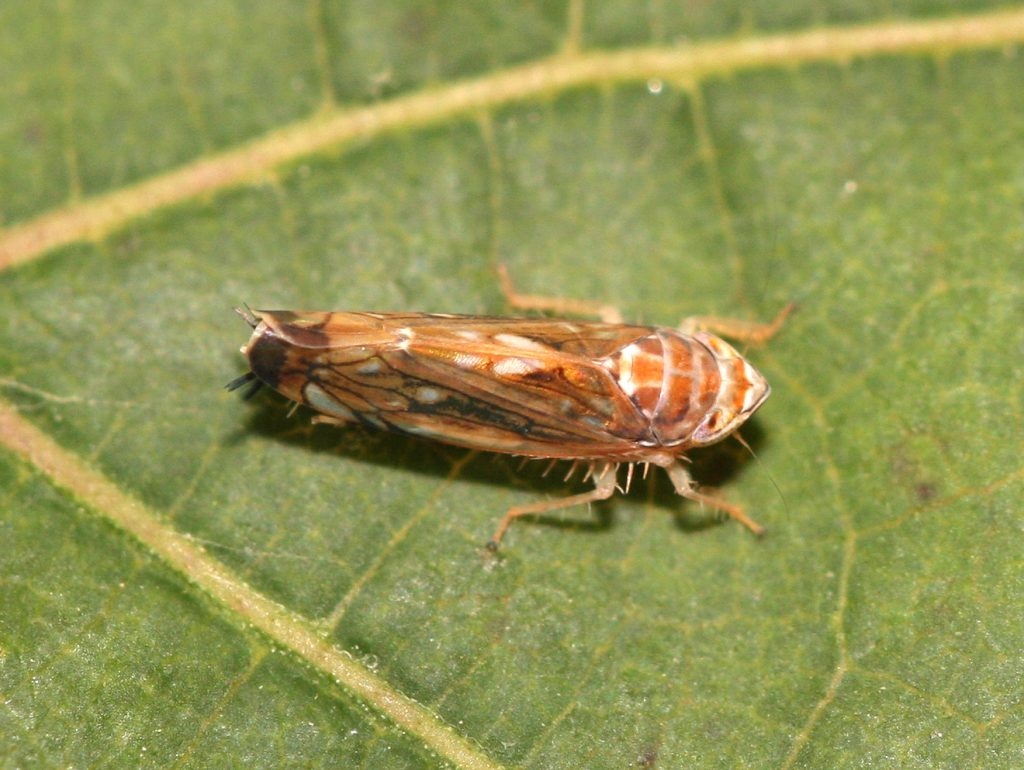
The bacterium is spread by an invasive insect introduced to Europe, the American grapevine leafhopper (Scaphoideus titanus), first spotted on the continent in 1958 in vineyards in southwestern France. In Hungary the leafhopper was found in 2006, and a nationwide survey of its populations was launched in 2007.
“For the epidemic to take off, an introduced vector had to turn up alongside a native pathogen. It was like bringing together two components of an adhesive,”
says Ferenc Samu, research professor at the Hungarian HUN-REN Centre for Agricultural Research. The result was a gradual, then increasingly conspicuous spread of the pathogen through Hungarian vineyards. The outbreak likely began to escalate around 2023, and weather factors, including a wetter spring, may have contributed to the wave of disease that drew so much attention in 2025. According to Ákos Molnár, Italy’s experience in the 1990s meant that all the information about the threat posed by the disease was already available. “But everyone in Hungary thought it wouldn’t happen to us,” he says.
In Europe, the leafhopper depends on the grapevine for both feeding and reproduction: it lays its eggs in cracks in the vine’s perennial woody parts. After hatching in spring, the young pass through five nymphal stages (L1–L5). The adults – far more mobile than the nymphs, and therefore more efficient at spreading the infection – appear in July.
Climate change, along with changes in land use and farming practices, has created more favourable conditions in Hungary for non-native species such as the American grapevine leafhopper, László Garamszegi says, while tourism and trade make it easier for invasive species to enter the country.
At the same time, over the past 10–15 years insecticide use has disappeared from routine grape growing, and leafhopper numbers have climbed.
According to Gergely Tholt, an engineer at the Plant Protection Institute of the HUN-REN Centre for Agricultural Research, for much of the 2010s even mass appearances of leafhoppers caused no problems, because the insects were not infected. Once that changed, even a handful of infected individuals could do devastating damage. And because of the infection’s incubation period, the leafhopper could spread the phytoplasma from plant to plant as much as a year before symptoms appeared.
The long symptomless period may have lulled growers into a false sense of security: they did not see right away that trouble was coming, even as the infection was already spreading.
According to László Garamszegi, exactly how the phytoplasma spreads between vineyards is still an open question. It can be carried by the leafhopper itself, but also by other insects, and there are other host plants that may help it move between vineyards. The pathogen can also enter a vineyard through infected propagation material. In the current epidemic, Molnár sees infected vines and the leafhoppers as the bigger risks for the disease’s spread.
This year, Romania’s plant health authority blamed infected propagation material for the disease reaching distant areas. Within the European Union, shipments of propagation material must carry a plant passport, but this certificate does not guarantee that they are free of infection.
The fight against flavescence dorée rests on three main pillars:
- detecting and removing infected vines as early as possible,
- killing the American grapevine leafhopper with insecticides,
- guaranteeing that propagation material is free of infection.
How well insecticides work depends heavily on how, and at what point in the year, spraying is done: Hungary’s Nébih considers it justified to start as early as May, when the first nymphal stage (L1) appears.
Because vines need to be sprayed precisely and at close range, experts say the helicopter spraying carried out in Hungary in autumn 2025 did not amount to genuine control.
According to Gergely Tholt, the response was also held back by the misconception that the epidemic could be managed by spraying alone, when spotting and removing diseased plants as early as possible is just as crucial.
Most experts say abandoned or poorly tended vineyards act as reservoirs for the pathogen and therefore pose a significant risk of infection. Clearing and managing them has been a key priority since last year. In Austria, the authorities in Burgenland alone sent 300 notices in 2026 to owners who had neglected their vineyards.
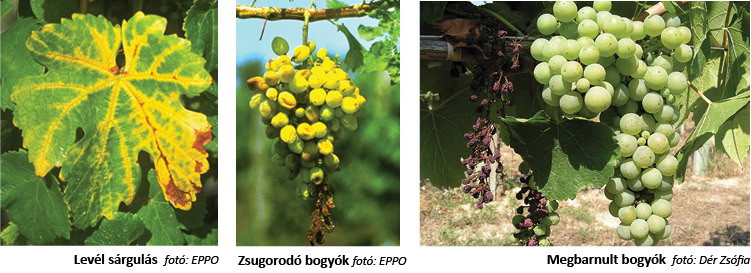
Plant pathologist Terézia Dula, speaking to Qubit, called for an assessment of how great a risk of infection abandoned vineyards pose.
Although the Austrian state provides no support for clearing infected areas, the authorities do take grubbing-up seriously. Under a Burgenland regulation in force since May this year, growers in areas declared infected zones must remove symptomatic vines and spray at least twice. Anyone who receives a notice to uproot their vines and fails to comply faces a fine of up to €6,000 per hectare.
“The authorities now have to enforce this strictly,” says Burgenland winemaker Mathias Jalits. “And maybe we also need a precedent – someone actually having to pay the fine.”
As of September 2026, no one in Burgenland had been fined, the state told DOSSIER. Even tougher measures were floated in Styria, where the state agriculture minister spoke in May of possible fines of €30,000.
DOSSIER found, however, that the fines actually imposed fell far short of that: in southeastern Styria, 21 fines were issued in 2025 and 2026, only one of which exceeded €1,000; all the others ranged from €100 to €350.
Hungary’s plant protection network was dismantled, and no one actively searched for diseased vines
In Hungary, the authority can order the removal of vines in infected areas, and impose a 1-kilometre quarantine zone, only once a case has been confirmed by laboratory testing. Nébih says that even before the epidemic surged in 2025, it was actively monitoring the disease’s spread in Hungary through a trap network for assessing leafhopper infestation, official field inspections, laboratory PCR diagnostics and an inspection system for propagation material.
“There was no active search for diseased vines,”
Gergely Tholt says of the 2013–2024 period, during which Nébih’s monitoring ran on low sample numbers. That was no accident.
“They dismantled the plant protection network. There aren’t enough specialists, and there’s no laboratory capacity either,” Terézia Dula told Qubit in the spring. Back in 2016, she had already sounded dire warnings in the trade magazine Bor és Piac about the threat posed by flavescence dorée.
According to Nébih’s response to Qubit’s freedom-of-information request, between 2013 and 2017 the number of samples tested rose from 377 to 2,889, and the number of positive samples from 37 to 401. The share of positive samples peaked in 2021, when 36 percent of the samples tested proved infected. The number of tests then fell considerably, hovering around 1,000 a year in 2022–2024, before rising sharply last year to a record 3,682.
Although mobile laboratories in Gyöngyös and Miskolc were brought into the effort in autumn 2025, only one accredited laboratory in Hungary can detect the phytoplasma to this day: Nébih’s National Plant Health Reference Laboratory. (The Soil and Plant Testing Laboratory at the John von Neumann University’s Faculty of Horticulture and Rural Development is in the preparatory phase of accreditation, which it is expected to obtain early next year.)
According to Ákos Molnár, detecting flavescence dorée – from sampling through laboratory testing to the issuing of an official order – sometimes took several months. All the while, the infected plant stayed in the vineyard, where it could keep spreading the disease.
In response to our freedom-of-information request, Nébih said that in March this year its laboratory testing capacity was 400 samples a month. Since autumn 2025 it has expanded its PCR diagnostic capacity and has also brought in drones fitted with AI-based recognition systems to help find infected vineyards. Of the 56,000 hectares of officially registered vineyards, 8,000 hectares were covered by in-person inspection, while vineyards larger than 80 hectares were assessed by drone, Péter Gál told Qubit.
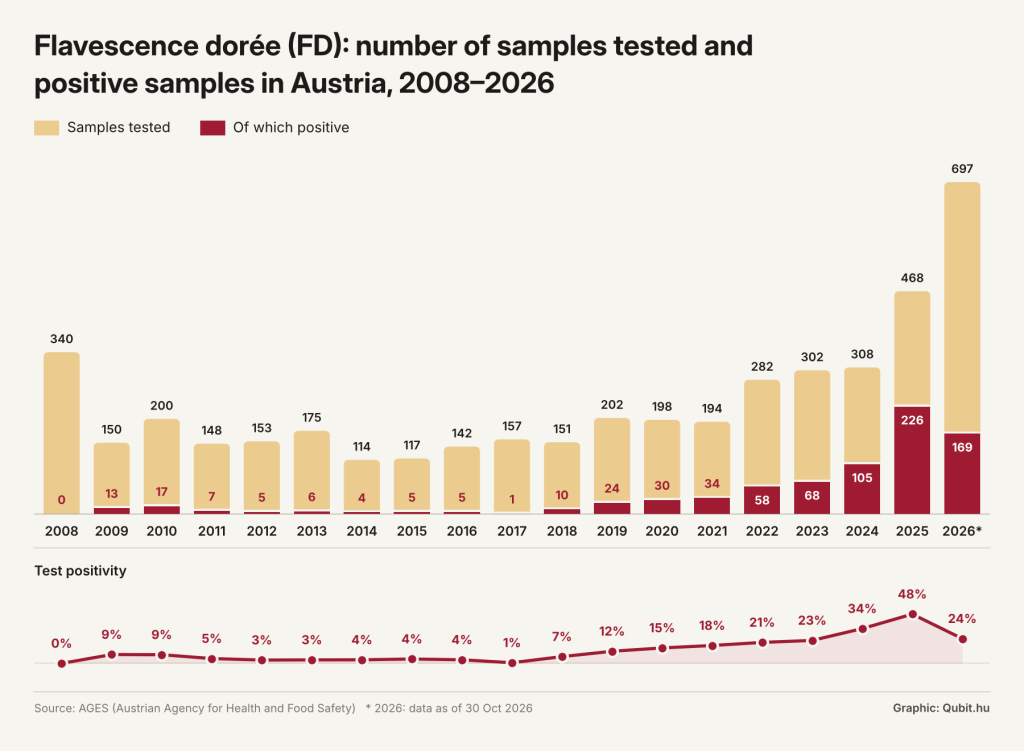
In Austria, AGES (the Austrian Agency for Health and Food Safety) has been responsible for collecting and analysing samples since the disease was first detected in 2009. A sharp increase in the number of samples submitted was recorded in 2025, with a new record of 697 samples reached in 2026. However, FD was detected less frequently than in the previous year. How can this be explained given the disease’s continued spread?
According to the AGES, “surveillance has been extended to areas where the FD epidemic is still at an early stage and where only isolated cases have been detected so far.” In other words, no further samples were collected in heavily affected areas because the presence of FD was already well established. This means that the 2026 figures do not, in fact, reflect the actual situation on the ground.
In Romania, in 2021 – the year the infection was detected – the national plant health authority (ANF) carried out four tests (yes, four), one of which came back positive, according to figures Átlátszó Erdély obtained through a freedom-of-information request.
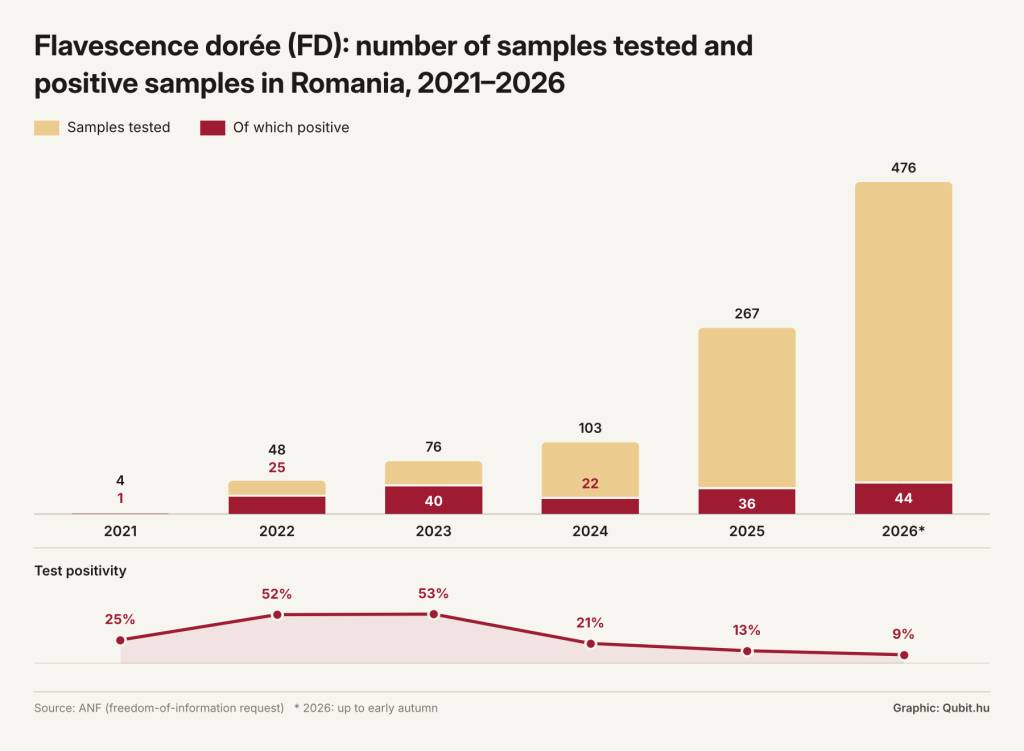
The authority took on responsibility for monitoring flavescence dorée when Romania joined the EU in 2007. Its public reports suggest that it was tracking the disease in the 2010s, but it is unknown how large an area it inspected or how many samples it tested. In 2026 the authority stepped up not only its communications but also its testing: by early autumn this year it had carried out 476 tests, 44 of which were positive.
In 2025, Hungary tested eight times as many samples, even though its vineyard area is a third the size of Romania’s. The two countries do have one thing in common: like Hungary, Romania has only a single accredited laboratory, near Bucharest, that can detect flavescence dorée by PCR testing.
The Romanian authority said, however, that it has expanded testing capacity over the past three years and can now carry out 100 tests a month. In a country where grapes are grown on 165,000 hectares and the plant health authority’s local offices have 265 staff, suspected infected areas are inspected on foot; no drones or remote sensing are used. According to the latest agricultural census, more than half a million farms in Romania grew grapes, a third of them on less than half a hectare – meaning the overstretched authorities would need to get information about phytoplasma to at least half a million people.
Romania’s rules set no penalties for growers who fail to report a suspected infection. According to Romania’s plant health authority, introducing them is not warranted, since growers cannot confirm the presence of the phytoplasma with a test themselves.
Neither nurseries nor growers want to pay for the treatment that guarantees infection-free propagation material
Flavescence dorée can spread through infected propagation material, yet replanting the vineyards grubbed up because of the epidemic is sharply increasing demand for that material. Nébih regards the mandatory official inspections, laboratory tests and plant health certification in propagation material production as an important part of the epidemic response.
Others would go further. The method recommended by the European Food Safety Authority (EFSA) for making propagation material infection-free is hot water treatment, an effective process that kills the phytoplasma. It is widely used across Europe but only sporadically in Hungary, and according to a statement Nébih made in May, suitable procedures for Hungarian grape varieties are still being worked out.
Ákos Molnár, who is also vice-president of the Hungarian Association of Grapevine Propagation Material Producers, named two main reasons why the method has not caught on: few heat treatment machines are available, and the high cost of treatment falls on the producers of propagation material.
Ákos Molnár is also managing director of Teleki Kober Szőlőoltvány Kft., a grafted-vine nursery that owns one of Hungary’s two certified heat treatment machines. In his experience the method can work, but because of the risk of damaging the plants and the costs involved, he considers heat treatment justified only when the propagation material is at risk – for example, if it comes from a nursery suspected of infection.
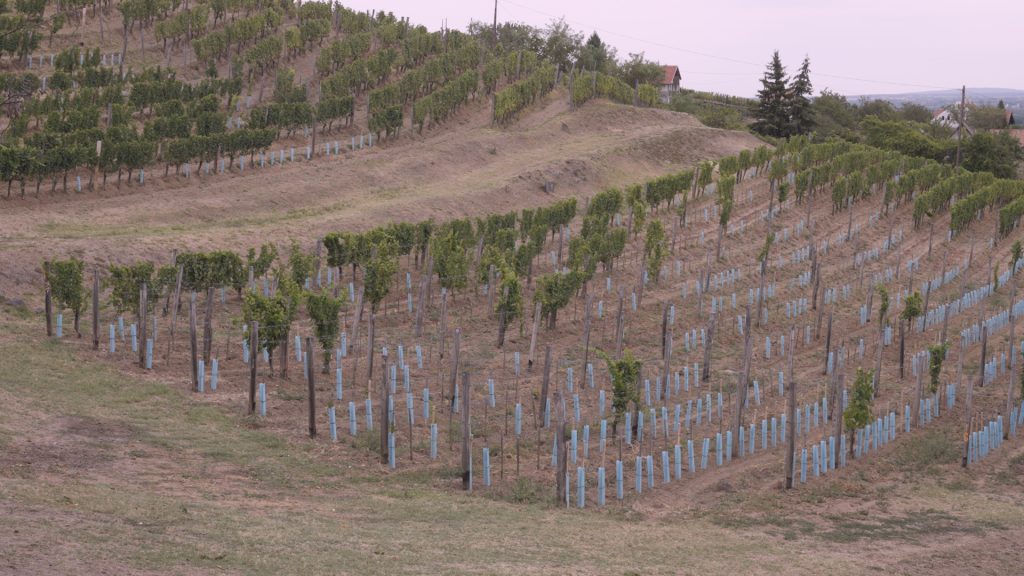
Terézia Dula would require all producers of propagation material to use hot water treatment, which the European and Mediterranean Plant Protection Organization (EPPO) also explicitly recommends for freeing material of phytoplasma and producing disease-free stock. The high cost of buying and running the machines pushes up the price of propagation material, but according to Ákos Molnár, growers are unwilling to pay the extra cost. Drawing on examples from abroad, he therefore proposes state subsidies for buying heat treatment machines, state-owned machines, or a system of machines bought and run jointly by producers.
According to Molnár, in recent years growers had no incentive to report the appearance of flavescence dorée because of the quarantine measures, the mandatory grubbing-up and the mountain of paperwork that came with them – and so the infection was able to spread from one vineyard to the next.
That is why, following Italian and French examples, they pushed for setting up inspection teams, which are organised and coordinated by the National Council of Wine Communities.
In Romania, there is no comparably organised and coordinated framework for regional cooperation – and so none for fighting flavescence dorée either. Stefan Polgar, who runs the Cluj-Napoca agricultural university’s 65-hectare teaching vineyard in Sibiu County, told Átlátszó Erdély that
phytoplasma is already present all over Romania; growers are simply afraid to talk about it openly because they don’t know what will happen to their vineyards.
Stefan Polgar himself called inspectors out to the teaching farm in August over a suspected infection, but by October he still had not been told the test results. Csaba Lengyel, a winemaker from Săcueni (Székelyhíd), also called in the plant health authority himself after symptoms of flavescence dorée appeared on his estate.
The lab test did not detect the phytoplasma, but he decided to grub up 250 vines anyway – and those plots will not bear grapes again for at least five years.
Romania’s ethnic Hungarian winemakers only sat up and took notice a year or two ago, when their counterparts in Hungary started telling them about flavescence dorée, said winemaker Géza Balla, head of the Association of Transylvanian Hungarian Winemakers – something a dozen winemakers confirmed to Átlátszó Erdély. In the spring, Dorin Popa, a retired agronomist from the University of Oradea, had not yet seen a similar sense of alarm among ethnic Romanian winemakers.
The Tisza government has sped up the response; in Austria and Romania, growers get no meaningful compensation
Around 50–60 percent of Hungary’s roughly 56,000 hectares of vineyards is now either infected or inside a buffer zone, Péter Gál said on Qubit’s podcast in early October.
What’s more, the trend shows no sign of slowing: according to the most pessimistic forecasts, 30–50 percent of Hungary’s vineyards could be lost to the infection and to poor management, says viticulturist and winemaker Bence Csizmadia, wine range development manager at the wine merchant Bortársaság.
The authorities began to take the fight against the disease seriously in 2024, and in autumn 2025 the then agriculture ministry set up a working group, coordinated by Péter Gál, to tackle the situation. Twelve years after the infection appeared, Nébih set up a working group of its own. Of its work, Róbert Tarsoly, president of the Zala Wine Region Council, said in the spring that
expert backed, issue-focused proposals routinely got stuck at the level of the authorities and the ministry’s political decision-makers.
Based on proposals drawn up jointly by the National Council of Wine Communities and the Ministry of Agriculture and Food Economy, in July the threshold for mandatory removal of an entire vineyard was lowered from 30 to 20 percent, compensation for a given vineyard became claimable more than once, and the maximum area eligible for pesticide subsidies was raised from 20 to 40 hectares.
The Hungarian growers who spoke to Qubit are still not satisfied, but the Austrian state treats its grape growers even more harshly: according to DOSSIER, growers receive no compensation whatsoever for grubbing up infected vines. In Romania, meanwhile, small growers complain that the agriculture ministry has not announced any compensation scheme, while in 2024 the lion’s share of replanting subsidies went to a single grape grower.
In Hungary, the ministry proposed a further legal amendment in August to tighten the fight against the phytoplasma, which parliament passed on 13 October. The amendment places particular emphasis on making it easier to grub up neglected plots that act as hotspots of infection. In practice, this means that infected vines on ownerless or state-owned vineyard holdings can be removed within about two months of being reported. The process remains lengthy: it begins with field surveys and continues with the testing of suspect samples – and the administrative apparatus that carries it out is fragmented and decentralised.
“There are nineteen government commissioners in the nineteen government offices. There are nineteen legal advisers, and despite Nébih’s professional oversight, nineteen different approaches to a single problem,” says Molnár.
Both Péter Gál and Ákos Molnár acknowledged that the authorities bore significant responsibility for the late start of the fight against the phytoplasma. Although the ministry has taken a more active role over the past two years, Nébih – which is responsible for testing infected vines and designating buffer zones – still suffers from a shortage of capacity and staff. Among the latest administrative developments is a mobile app developed at the initiative of the National Council of Wine Communities. It could be made available to users, but according to Molnár, the authorities first have to overcome the data protection hurdles that come with it.
The president of the Sopron wine region said the app would support the control process with two functions. First, uncultivated vineyards could be reported with a georeferenced photo, sparing the authorities a site visit. Second, symptomatic vines could be flagged and documented. Although the Tisza government tightened the response to flavescence dorée further after taking office, the disease’s consequences reach beyond politics and beyond any one government’s term in office.
The winemakers and experts Qubit spoke to were unanimous that growers who cultivate grapes as a hobby – or who do not supply the broader market – could easily be squeezed out by the extra costs and technical burdens flavescence dorée brings.
We have to learn to live with it
Based on last year’s experience, Gergely Tholt and Ferenc Samu believe Hungary may still be in the early phase of the flavescence dorée surge. They expect the situation to get even worse this year and next. In Burgenland, meanwhile, experts at the federal Agency for Health and Food Safety (AGES), which monitors the spread of the American grapevine leafhopper, found 262 leafhoppers in their traps at one monitoring site last year, but only 32 this year, and saw a similar downward trend in southeastern Styria. In Romania, it is not yet clear whether the greater attention flavescence dorée has received this year will spur growers to organise themselves and fight back more effectively.
According to László Garamszegi, given Hungary’s geographic position, nothing could have stopped the invasive American grapevine leafhopper – the phytoplasma’s vector – from arriving around 2006. The authorities could, however, have responded early: an effective monitoring system could have softened the impact. Yet even 20 years after the leafhopper was first found in Hungary, no such system has been built.
Terézia Dula believes control measures should have been made mandatory as soon as the American grapevine leafhopper became established in Hungary. In her view, this could have stopped flavescence dorée from getting out of hand.
The same factors that let the flavescence dorée epidemic worsen beneath the surface for years – from a lack of state capacity to the looking-away Ákos Molnár describes – resurface in how even more consequential threats are handled. Think of the Covid pandemic, the global spread of H5N1 bird flu and its adaptation to mammals, or climate change.
The goal is no longer to eliminate the pathogen – that is now definitely impossible – but to push it back as far as possible, says Róbert Tarsoly.
“We’ll have to live with both the leafhopper and the phytoplasma for the long term,”
says László Garamszegi as well. That calls for a new long-term vineyard management strategy, one that integrates the fight against flavescence dorée with defences against other risks. “Eradication is no longer possible,” agrees Helga Reisenzein of the Austrian Agency for Health and Food Safety (AGES). “Sooner or later, we’ll have to learn to live with it.”
The future of Hungarian, Austrian and Romanian vineyards now hinges on whether we can.
Cover photo: Edit Éva Pál
This article was produced in collaboration between Qubit, 444, Átlátszó Erdély, and DOSSIER, with the support of Journalismfund Europe. Contributing journalists: András Tóth, Sarolta Kuglics (Qubit), Albert Gazda (444), Tünde Szabó (Átlátszó Erdély), and Elisa Tomaselli (DOSSIER).


